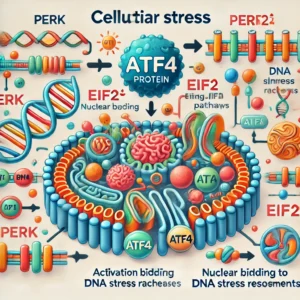
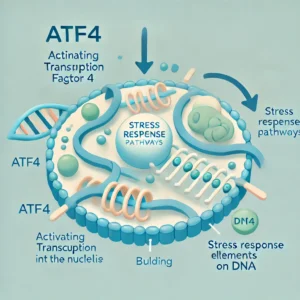
ATF4 Antibody is a high-specificity polyclonal antibody designed to target ATF4 (Activating Transcription Factor 4), a key transcription factor involved in cellular stress responses, metabolic regulation, and apoptosis. ATF4 plays a critical role in the integrated stress response (ISR) pathway, regulating genes essential for amino acid metabolism, redox balance, and protein homeostasis.
Key Features
- Specificity: High specificity for ATF4 with minimal cross-reactivity to other ATF family members.
- Applications: Validated for Western Blot (WB), Immunohistochemistry (IHC), Immunofluorescence (IF), and Chromatin Immunoprecipitation (ChIP).
- Polyclonal Nature: Broad epitope recognition ensures robust detection in multiple species.
- Purity: Affinity-purified to reduce background noise and enhance sensitivity.
Specifications
| Attribute | Details |
|---|---|
| Immunogen | Synthetic peptide derived from the C-terminal region of ATF4 |
| Host Species | Rabbit |
| Isotype | IgG |
| Reactivity | Human, Mouse, Rat |
| Applications | WB, IHC, IF, ChIP, ELISA |
| Formulation | PBS, pH 7.4, with 0.09% sodium azide and 50% glycerol |
| Concentration | 0.5 mg/mL |
Applications
1. Western Blot (WB)
- Detect ATF4 protein levels in lysates from various cell lines or tissues.
- Applications: Stress response studies, cellular metabolism research, cancer biology.
2. Immunohistochemistry (IHC)
- Localize ATF4 expression in formalin-fixed paraffin-embedded (FFPE) tissues.
- Applications: Evaluating ATF4 involvement in neurodegeneration, ischemia, or metabolic disorders.
3. Immunofluorescence (IF)
- Visualize ATF4 within cellular compartments using fluorescence microscopy.
- Applications: Studying ATF4 nuclear translocation under stress conditions.
4. Chromatin Immunoprecipitation (ChIP)
- Investigate ATF4 binding to promoter regions of stress-response genes.
- Applications: Gene regulation studies, epigenetic research.
5. Enzyme-Linked Immunosorbent Assay (ELISA)
- Quantify ATF4 protein levels in biological samples.
- Applications: High-throughput screening for ATF4 modulation.
Recommended Protocols
1. Western Blot
- Prepare lysates from cells or tissues (20-30 µg protein per lane).
- Separate proteins on SDS-PAGE and transfer to PVDF or nitrocellulose membranes.
- Block membrane with 5% BSA in TBST for 1 hour.
- Incubate with ATF4 antibody (1:1,000 dilution) overnight at 4°C.
- Wash and incubate with HRP-conjugated secondary antibody (1:10,000 dilution) for 1 hour.
- Visualize bands using enhanced chemiluminescence (ECL) substrate.
2. Immunohistochemistry
- Deparaffinize and rehydrate tissue sections.
- Perform antigen retrieval using citrate buffer (pH 6.0) at 95°C for 10 minutes.
- Block with 5% normal serum for 30 minutes.
- Incubate with ATF4 antibody (1:200 dilution) for 1 hour at room temperature.
- Apply secondary antibody and visualize using DAB chromogen.
3. Immunofluorescence
- Fix cells with 4% paraformaldehyde for 15 minutes.
- Permeabilize with 0.1% Triton X-100 for 10 minutes.
- Block with 3% BSA for 30 minutes.
- Incubate with ATF4 antibody (1:500 dilution) for 1 hour.
- Apply fluorescently labeled secondary antibody and counterstain with DAPI.

Research Applications
- Stress Response Studies: Investigating ATF4’s role in the integrated stress response pathway.
- Cancer Research: Understanding ATF4’s involvement in tumor cell survival under hypoxic and nutrient-deprived conditions.
- Neurodegeneration: Exploring ATF4’s role in ischemia-induced neuronal death and diseases like Alzheimer’s and Parkinson’s.
- Metabolic Disorders: Studying ATF4-mediated regulation of amino acid metabolism and oxidative stress.
- Epigenetics and Gene Regulation: Decoding transcriptional regulation under cellular stress.
Storage and Stability
- Storage Conditions: Store at -20°C for long-term use. For frequent use, aliquot to avoid freeze-thaw cycles.
- Stability: Stable for 12 months when stored as recommended.
Safety Information
This product contains sodium azide as a preservative. Handle with care and follow proper laboratory safety procedures.
References
- Stress Response Pathways: PubMed: ATF4 Function in Stress
- Cancer Research: NIH Research Resources
- ATF4 Gene Regulation: KEGG Pathways